


"*" indicates required fields
Take a look at our FAQ’s. We’ve got plenty of helpful tips and answers waiting for you.
Wheelchair users spend much of their time in their motorized wheelchair. It’s not only important that the wheelchair meets a user’s medical needs, but the wheelchair should also help maximise independence and quality of life. Manufacturers offer a range of accessory options to enhance a user’s lifestyle.
For example, the Edge 3 Stretto Power Chair comes standard with LED front and rear fender lights. These lights are ultra-bright, long-lasting and integrated above each drive wheel for compactness and durability. They help users see and be seen when crossing streets or parking lots at night and are also useful at home when visibility is low. LED fender lights are also standard on other models such as iLevel, Edge 3 and the 4Front 2.
A USB charger comes standard on some power chairs, allowing users to charge electronic devices while on the go by plugging directly into the controller of the chair.
Other accessories are available when selecting a specific seating system, for example the TRU-Balance 3 or TRU-Balance 3 HD. A complimentary cup holder is included with these seating systems. Additional medically-based accessories include a vent tray for portable ventilators, transfer bars, or an oxygen holder.
For storage and convenience, other accessories include a glove box, backpack, personal item hook, rear accessory bar, tablet holder and phone holder. These allow users to personalise the chair and keep essential items accessible.
Accessories let you tailor the wheelchair to your lifestyle and daily activities. Whether you need added visibility, storage, mobile device charging, medical equipment support or extra holding options, the right accessories enhance comfort, safety and independence.
A power wheelchair is more than its base model. Accessories transform it into a personalised mobility solution. By selecting the right accessories for your daily routines and needs, the chair supports your life, not just your mobility.
With so many power wheelchairs available today, choosing the right electric wheelchair can feel overwhelming. The key is to focus on the chairs and features that best suit your needs.
The first step is to request an in-person evaluation with a therapist. The therapist works with an Assistive Technology Professional (ATP) from an accredited complex rehab technology company. Together, they determine which electric wheelchair and components will provide the most benefit for your medical and quality-of-life needs.
The first decision is choosing a power base. Two important factors are drive wheel configuration and weight capacity. Available configurations include front-wheel, mid-wheel, and rear-wheel drive.
Next, seating and positioning needs are discussed. Some users may only require a standard captain’s seat, while others may benefit from single power or multiple power options.
Highly adjustable TRU-Balance® 3 Power Positioning Systems include features such as:
Power tilt
Power recline
iLevel® power elevating seat
Power articulating foot platform
TRU-Balance 3 supports pressure relief, increased sitting tolerance, and independent positioning and repositioning.
The Q-Logic 3 Advanced Drive Controls system is highly customisable and expandable, helping users maximize independence. It includes Bluetooth functionality, allowing operation of smartphones or tablets directly from the Q-Logic 3 screen.
Your ATP may recommend a cushion from Stealth Products®. Cushions support comfort, skin protection, and positioning. For example, the TRU-Comfort 2 cushion combines pressure relief and positioning with CoolCore®technology for added comfort.
When choosing an electric wheelchair, clear communication with your therapist and ATP ensures the chair fits your needs. From drive base and seating system to electronics and cushions, each component should match your lifestyle, medical requirements, and daily activities.
Choosing the right electric wheelchair involves careful evaluation of your needs, drive base, seating, controls, and accessories. Quantum Rehab designs its complex rehab power wheelchairs to meet medical and quality-of-life needs, giving users independence, comfort, and advanced technology tailored to their lifestyle.
When selecting a complex rehab motorised wheelchair, one of the key factors to consider is the drive wheel configuration. Among front‑, mid‑ and rear‑wheel drive bases, a mid‑wheel drive configuration offers several distinct advantages.
In a mid‑wheel configuration the drive wheels are positioned roughly under the user’s centre of gravity. The base typically has six wheels on the ground: two drive wheels plus four caster wheels (front and rear) which enhances stability. The user’s turning radius is the tightest in this configuration.
Because the drive wheels are under the user’s centre of gravity, the turning radius is very small. The user can perform a full 360‑degree turn, which is particularly beneficial indoors, for example when navigating doorways and narrow spaces.
The six‑wheel configuration provides excellent stability: having caster wheels both in front and behind the drive wheels helps prevent tipping forward or backward.
Mid‑wheel drive chairs offer good traction on many surfaces, including inclines and side slopes, and they handle small obstacles or curbs well.
The design is intuitive and often has a shorter learning curve, making it a strong choice especially for first‑time power wheelchair users.
Because of its attributes, mid‑wheel drive is often an excellent fit for users who primarily use their chair indoors, where manoeuvrability and tight turns matter most.
If your therapist and ATP believe mid‑wheel drive is the right match for your needs, then you may want to explore models that are built around this configuration and that offer compatible seating, positioning and control options.
A mid‑wheel drive power wheelchair is a great choice when indoor manoeuvrability, tight turning radius and maximum stability matter. By choosing the right drive wheel configuration in consultation with your therapist and ATP, you increase your chance of finding a chair that truly supports your independence and daily life.
Power chairs with elevating seat technology are becoming increasingly popular across Europe, providing users with greater independence and functionality in everyday life. Quantum Rehab’s iLevel® series offers a unique solution, allowing users to elevate to eye level while maintaining mobility. This blog explains how the iLevel® works, its key benefits, and what European users should consider.
The iLevel® is an advanced power chair featuring an electric seat‑elevating mechanism that allows the user to raise the seat while driving. This capability enables users to reach shelves, counters, and other high surfaces that would otherwise be out of reach.
One of the key innovations is Quantum Rehab’s Extra Stability Technology®, which ensures that the chair remains stable and safe, even at maximum seat elevation. This is crucial for performing daily tasks such as reaching, transferring, or interacting with others at eye level.
Extended reach: With the seat elevated, users can comfortably access kitchen counters, cabinets, shop shelves, or participate in meetings without assistance.
Improved daily functionality: Everyday activities such as cooking, grooming, and dressing become more accessible.
Greater independence: Unlike standard power chairs, the iLevel® empowers users to interact with their environment on their own terms.
Enhanced safety: Extra Stability Technology® ensures that driving at elevated positions remains safe and stable.
While the iLevel® offers remarkable benefits, European users should keep a few points in mind:
Regulations and classification: In most EU countries, advanced power chairs may be classified as medical devices or special-purpose vehicles. It is important to check that the chair complies with EU standards such as the Medical Device Regulation (MDR).
Options and adaptations: Depending on local regulations and individual needs, users may require specific safety accessories, such as lights or reflective elements, for outdoor use.
Training and familiarization: Although formal training is not mandatory, learning to safely operate an elevating power chair is highly recommended. Local mobility suppliers or rehabilitation centres often offer orientation sessions.
Indoors: Perfect for homes, offices, and public buildings. EU accessibility laws require public spaces to accommodate mobility devices, so elevated access can improve interaction and independence.
Outdoors: European users should verify local road and pavement regulations for power chairs, especially when driving at elevated positions. Some countries limit use to pedestrian zones or require speed restrictions.
The iLevel® power chair offers an innovative way to enhance independence, extend reach, and improve daily functionality. For European users, understanding local regulations, using the chair safely, and exploring training opportunities ensures that you can fully benefit from this advanced mobility technology.
Power wheelchairs have evolved considerably over time. This blog takes a look at their origins, modern features, and what the future may hold.
Self‑propelled wheelchairs date back centuries. For example:
In 1655, a paraplegic watchmaker named Stephan Farffler invented one of the earliest self‑propelled wheelchairs, using hand cranks and cogwheels.
In the 1760s, James Heath of Bath, England, created the “Bath Wheelchair”, a carriage‑style mobility device that was pushed or drawn by another person or horse.
In 1916, the first motorised wheelchair was created in London, though it did not reach mass production.
In the 1950s, Canadian inventor George Klein developed the first electrically powered wheelchair to assist veterans of the Second World War.
Today’s power wheelchairs incorporate advanced suspension, positioning systems and customisation. For example, the Quantum Rehab Edge 3 features Smooth Ride Suspension (SRS) for a smoother ride and advanced stability. Its TRU‑Balance® 3 Power Positioning System offers options such as power recline, power tilt, power articulating leg rests and iLevel® power adjustable seat height.
The iLevel® technology allows users to remain mobile while their seat is elevated providing improved reach, transfer capability and interaction at eye‑level with others.
Looking ahead, emerging features may include brain‑controlled interfaces, self‑guiding mobility via programmed routes, luxurious seating experiences, extended battery life, and even stair‑climbing capabilities. These innovations aim to further enhance independence, comfort and lifestyle for power wheelchair users.
From early hand‑cranked chairs to today’s sophisticated models with elevating seats and advanced positioning systems, the evolution of power wheelchairs has been dramatic. Selecting a modern chair that fits your needs means choosing a device built for today and ready for tomorrow.
Keeping your power wheelchair clean is important for its longevity, appearance and safe operation. Below are the main cleaning steps and checks you should perform.
Wipe the seat and frame with a soft, dry cloth. Avoid abrasive cleaners, chemicals and lubricants, as these can damage the electronics.
Immediately clean up moisture and spills to prevent damage or corrosion.
While the controller is turned off, check the joystick: ensure it is not bent or damaged and that it returns to its neutral position when released. Inspect the rubber boot around the joystick base; if it is damaged, contact your provider.
Check the controller harness for fraying or exposed wires. If issues are found, contact your provider.
Keep the wheelchair free of foreign material such as mud, dirt, hair, food or drink.
Visually inspect suspension components such as spring shocks or gas dampers for damage or bending. If abnormalities are found, consult your provider.
Regular cleaning helps maintain the function of sensitive components such as the joystick, electronics and frame structure. Preventing corrosion, buildup of debris and damage ensures the wheelchair continues to perform safely and comfortably.
A motorised wheelchair is a complex device with electronics, mechanical parts and user interfaces. Simple daily cleaning and inspection routines ensure reliability, safety and comfort. Using a soft cloth, avoiding harsh chemicals, addressing moisture promptly and doing visual checks routinely supports both your mobility and the longevity of your equipment.
When selecting a base for a complex rehab power wheelchair, the drive wheel configuration is a key consideration. Rear‑wheel drive offers many benefits, especially for outdoor and more demanding terrain.
In a rear‑wheel drive configuration the two large drive wheels are positioned at the back of the base, with two casters at the front. The placement of the drive wheels provides the source of the wheelchair’s propulsion power.
Extra power: A rear‑wheel drive power wheelchair can perform better on more aggressive outdoor terrain and push forward through softer surfaces.
Stability and ride comfort: These models typically include independent suspension or shock absorbers on all wheels, which helps deliver a smoother ride experience on uneven ground.
Better control: The turning speed of the chair is slower in a rear‑wheel drive configuration, giving the user more time to adjust their joystick and complete turns safely.
Large drive area: With the weight of the chair focused where the drive wheels are located and a larger base, the stability is enhanced under many conditions.
If you spend a lot of time outdoors, encounter uneven terrain, soft ground or slopes, or require a chair with strong stability and traction, a rear‑wheel drive power wheelchair may be the right fit. It is also beneficial where ride comfort on challenging surfaces is important.
A rear‑wheel drive power wheelchair provides strong performance, enhanced stability and improved control making it an excellent choice for users with outdoor mobility needs and those navigating more demanding surfaces. Working with your therapist and ATP to match this configuration to your lifestyle and environment ensures you get the best possible support.
As a rule of thumb, electric wheelchairs should not get wet. However, life happens, sometimes it rains unexpectedly or you may need to drive through a puddle.
Even though the manufacturer’s power chairs have passed the necessary testing for liquid ingress, prolonged or direct exposure to water or damp conditions is not advisable. Such exposure could cause both electronic and mechanical malfunction. Water can corrode electrical components and cause the frame to rust.
Electric wheelchairs should also be inspected periodically for signs of corrosion caused by moisture exposure, bodily fluids or incontinence. Damaged components must be replaced or treated immediately.
If your power wheelchair does come into contact with water:
Dry the chair as thoroughly as possible using a towel.
Allow the chair to sit in a warm, dry place for approximately 12 hours to allow any unseen water to evaporate.
Afterwards, check joystick operation and brakes before using the chair again.
If any inconsistencies are found, take the chair to an authorised provider for inspection. If the chair is frequently exposed to water, bodily fluids or incontinence, it should be inspected often for corrosion and electronic components may need replacing.
Use a damp cloth and mild, non‑abrasive cleanser to clean plastic and metal parts of the wheelchair. The chair body may include a painted ABS plastic shroud which allows for easy wiping. If required, use a disinfectant only if it is approved for use on the mobility chair. Do not use harsh chemicals on a vinyl seat as they may cause it to become slippery or crack. Clean the seat with soapy water, then dry thoroughly. Never hose off a power wheelchair or place it in direct contact with water.
A motorised wheelchair is a complex device made up of electronics, mechanical parts and user interfaces. While these devices are built for durability and mobility, avoiding direct and prolonged exposure to water ensures safety and prolongs lifespan. When a chair does get wet, a prompt drying and inspection routine helps protect your investment and your independence.
When selecting a base for a complex rehab power wheelchair, the drive wheel configuration is an important factor. Front-wheel drive offers several advantages compared to mid-wheel or rear-wheel drive, depending on the user’s environment and needs.
With front-wheel drive, more weight is placed on the drive wheels, which increases traction. This helps the chair perform better on softer surfaces such as grass or loose gravel.
The drive wheels are at the front and encounter obstacles first. The larger wheels can climb over curbs or small steps, pulling the rest of the chair along.
Users’ feet can be positioned closer to the body because there are no front casters, which improves comfort. 90° footrests can also be added.
Front-wheel drive allows a lower seat-to-floor height. This helps the chair fit under tables and desks more easily, enhancing social interaction and accessibility.
Indoor performance is also improved, as tight corners and small spaces can be navigated more easily.
Quantum Rehab cites the 4Front® 2, a front-wheel drive power wheelchair with Smooth Ride Suspension (SRS) and Smart Traction Control (STC). This model offers optional seat elevation and is designed to handle obstacles and uneven surfaces efficiently.
Front-wheel drive is an excellent option if the user primarily operates indoors or navigates tight spaces, desks, and tables. It also provides extra traction on soft or uneven surfaces outdoors.
A front-wheel drive power wheelchair delivers benefits in traction, foot positioning, seat-to-floor height, and maneuverability. Working with a therapist and ATP ensures that this configuration matches the user’s specific needs and lifestyle.
Electric wheelchairs vary considerably in weight. For advanced complex rehab power chairs, customised systems and accessories can significantly increase the overall mass of the chair.
Seating systems add substantial weight to a motorised wheelchair. For example, the TRU‑Balance® 3 Power Positioning Systems from the manufacturer include features such as power tilt, power recline, elevating seat height via iLevel®, static seating or manual recline.
Foot rigging options also influence weight. Options include articulating foot platforms, swing‑away leg rests, elevating leg rests, base‑mounted foot platforms, drop‑in leg rests and adjustable centre‑mount foot platforms. Some of these choices make the chair heavier than others.
Accessories are another factor. Add‑ons such as a cup holder, glove box, backpack, vent tray and other personalised accessories increase the overall weight of the power chair.
Because of all the possible combinations of base, seating system, foot rigging and accessories, a precise estimated overall weight must be determined before ordering. This is especially important for transport: vehicle lifts, ramps, accessible vans and public‑transport compatibility all depend on the actual weight of the chair. The manufacturer weighs every power chair in production after assembly so that the serial number can be used to identify the exact weight later by a support technician.
When choosing a power wheelchair, be sure to consider the weight of the full configuration including the base, seating system, foot rigging and accessories. Understanding the total weight helps ensure compatibility with transport and accessibility solutions, and supports safe everyday use.
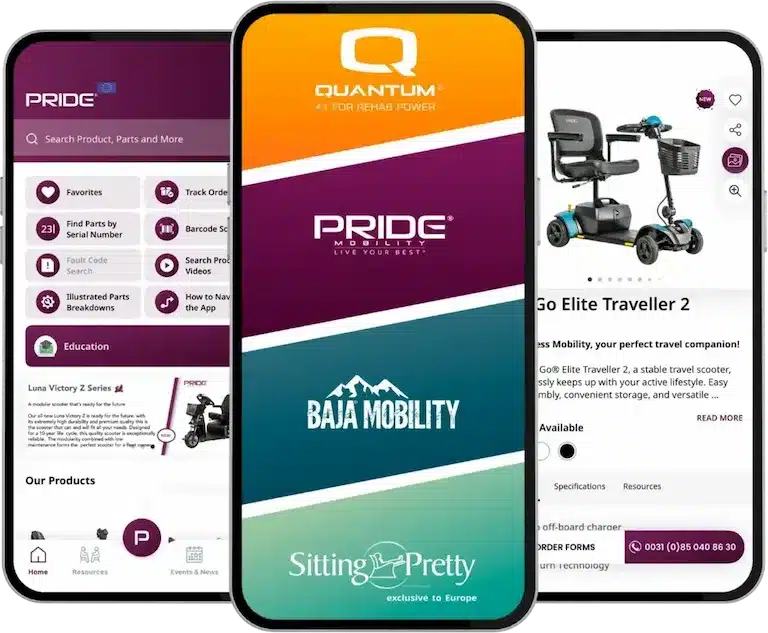
Get instant access to products, manuals, order tracking, and more with the PQ-365 app. Download the Pride Mobility app today.